
1. Introduction: The Global Mobility of Nursing Talent and the Dubai Imperative

The contemporary healthcare landscape is defined by an unprecedented fluidity of talent. As nations grapple with ageing populations and evolving epidemiological profiles, the demand for skilled nursing professionals has transcended borders, creating a global marketplace for clinical expertise. Within this dynamic ecosystem, the Emirate of Dubai has emerged not merely as a destination but as a premier hub for medical excellence. The Dubai Health Authority (DHA), the regulatory body overseeing the emirate’s health sector, has curated a rigorous licensure process designed to filter this global influx of talent, ensuring that only those who meet the highest standards of patient safety and clinical competence are granted the privilege to practice.
However, a stark statistical reality looms over this aspirational pathway. Industry observations, educational data, and candidate testimonials suggest that a significant proportion of applicants—estimated at nearly 40%—fail to clear the DHA Prometric Examination on their first attempt. This attrition rate is not merely a reflection of academic difficulty; it is symptomatic of a broader disconnect between international nursing education models and the specific, application-based assessment logic employed by the DHA.
This report serves as an exhaustive deconstruction of the DHA nursing licensure examination. It is designed for nursing professionals, recruitment strategists, and educational consultants. We will dissect the structural, psychological, and administrative factors contributing to high failure rates, analyse the 2025 exam syllabus in granular detail, and propose a data-driven strategic framework for preparation. Furthermore, we will explore the economic implications of licensure, contrasting the high-stakes nature of the exam with the lucrative rewards of the Dubai healthcare market. By bridging the gap between clinical bedside manner and standardised testing protocols, this document aims to transform the 40% failure statistic into a roadmap for professional success.
Centralized portfolio overview with Lunexora Investment-Plattform official website transparent reporting.
2. The Economic and Professional Value Proposition of the DHA License

To understand the intense pressure that leads to examination failure—commonly referred to as “high-stakes test anxiety”—one must first quantify the value of the prize. The DHA license is arguably one of the most valuable portable credentials in the Global South and emerging markets, offering a transformative leap in economic status and professional trajectory.
2.1 Comparative Economic Analysis: The “Salary Arbitrage” Effect
The primary driver for the migration of nurses from countries such as India, the Philippines, and various African nations to Dubai is economic arbitrage. The discrepancy in compensation is profound, often exceeding a 300-500% increase in disposable income, particularly when factoring in the tax-free environment of the United Arab Emirates (UAE).
Table 1: Comparative Nursing Compensation & Benefits Analysis (2025 Estimates)
| Socio-Economic Factor | Dubai (UAE) | Philippines | India | United Kingdom (NHS) |
| Average Monthly Salary | AED 4,000 – AED 9,000+ (approx. USD 1,100 – 2,500) | PHP 15,000 – 30,000 (approx. USD 270 – 540) | INR 20,000 – 50,000 (approx. USD 240 – 600) | GBP 2,500 (approx. USD 3,100) |
| Taxation Structure | 0% Personal Income Tax | Progressive Income Tax (20-30%) | Progressive Income Tax (10-30%) | Mandatory (approx. 21 days’ salary per year of service) |
| Housing Benefits | Often provided (shared) or Housing Allowance included | Rare (Personal responsibility) | Rare (Personal responsibility) | Rare (Personal responsibility, high cost) |
| End-of-Service Gratuity | Mandatory (approx. 21 days’ salary per year of service) | Varies / Limited | Provident Fund (Contributory) | Pension (Contributory) |
| Annual Leave & Travel | 30-45 Days + Annual Flight Ticket Home | Standard (~15 days) | Standard (~15-20 days) | Standard (~28 days) |
Analysis of Economic Data:
The data presented in Table 1 illustrate a compelling narrative. A nurse in the Philippines earning roughly $400 USD a month, subject to tax, faces a fundamentally different economic reality than a DHA-licensed nurse in Dubai earning $2,000 USD tax-free with housing covered. The “take-home” pay differential can be tenfold.4 This economic cliff creates immense psychological pressure. For many candidates, the DHA exam is not just a test of nursing knowledge; it’s a gateway to family financial stability, debt repayment, and upward social mobility. This “all-or-nothing” mindset contributes significantly to the anxiety-induced failures observed in the 40% statistic.
2.2 The Professional Ecosystem: Facilities and Standards
Beyond direct compensation, the Dubai healthcare sector offers exposure to world-class infrastructure. The DHA regulates a mix of government hospitals (e.g., Rashid Hospital, Dubai Hospital) and high-end private facilities (e.g., American Hospital, Mediclinic).
- Technological Integration: Nurses in Dubai often work with Electronic Health Records (EHR) and advanced diagnostic equipment that may not be available in resource-limited settings.
- Standardisation: The sector operates under strict International Patient Safety Goals (IPSG) and JCI (Joint Commission International) accreditation standards. The DHA exam is explicitly designed to test familiarity with these global standards, which often catches candidates from non-accredited backgrounds off guard.
2.3 Regulatory Fragmentation: DHA vs. MOH vs. DOH
A critical source of confusion for international applicants is the federal structure of the UAE. Failure often stems from preparing for the wrong regulator’s exam style.
- DHA (Dubai Health Authority): Exclusive to the Emirate of Dubai. The focus of this report.
- DOH (Department of Health – Abu Dhabi): Formerly HAAD. Governs Abu Dhabi and Al Ain. Known for a slightly different blueprint and stricter data transfer rules.
- MOHAP (Ministry of Health and Prevention): Governs the Northern Emirates (Sharjah, Ajman, RAK, etc.).
- DHCC (Dubai Healthcare City): A free zone with its own specific licensure requirements, separate from standard DHA.
Strategic Implication: A nurse cannot simply study “for the UAE.” They must study specifically for the DHA’s “Mode of Exam,” which prioritises the urban, cosmopolitan disease profile of Dubai (e.g., lifestyle diseases, road trauma, elective surgeries) over the perhaps different focuses of other regions.
3. Anatomising the Failure: Why 40% of Nurses Do Not Pass

The statistic that nearly 4 out of 10 nurses fail the DHA exam on their first attempt is a composite figure derived from various educational bodies and candidate forums. To address “how to avoid it,” we must first perform a root cause analysis of why it happens. The failure is rarely a total lack of medical knowledge; rather, it is a failure of adaptation.
3.1 The “Recall vs. Application” Cognitive Gap
The most pervasive reason for failure is the reliance on rote memorisation. Many nursing curricula in source countries emphasize the retention of facts (e.g., “What is the normal range for sodium?”). However, the DHA exam—administered via Prometric—utilises Single-Best-Answer MCQs that require higher-order cognitive processing.
Table 2: The Cognitive Hierarchy of DHA Questions.
| Question Type | Cognitive Level | Example Logic | Failure Risk |
| Recall / Knowledge | Low | “Identify the normal pH of blood.” | Low. Most nurses know facts. |
| Comprehension | Medium | “Explain why a patient with COPD retains CO2.” | Moderate. Requires understanding physiology. |
| Application | High | “A patient with COPD has an O2 sat of 88%. Which action does the nurse take first?” | High. Requires applying rules to a specific scenario. |
| Analysis / Synthesis | Very High | “A patient with COPD has an O2 saturation of 88%. Which action does the nurse take first?” | Critical. This is where most failures occur. |
Analysis:
In “Analysis” questions, all four options might be correct nursing actions (e.g., document the finding, call the doctor, assess vital signs, give oxygen). The exam tests the ability to identify the priority. Candidates who fail often choose a correct action that is not the immediate priority, demonstrating a lack of understanding of the “triage logic” (Airway-Breathing-Circulation or Maslow’s Hierarchy) embedded in the exam.
3.2 The “Prometric Shock”: Environmental Stressors
The testing environment itself acts as a filter. The Prometric centres operate under strict security protocols that can intimidate unprepared candidates.
- The Timer: Candidates have 165 minutes to answer 150 questions. This equates to approximately 66 seconds per question.
- The Failure Mechanism: Candidates who have not practised paced breathing or timed simulations often panic. A Reddit user recounted “misjudging the time” and leaving 30 questions unanswered. In a weighted exam, leaving 20% of the paper blank guarantees failure.
- Calculator Policies: Physical calculators are banned. Candidates must use the on-screen calculator.18 Unfamiliarity with the interface’s UI/UX causes unnecessary friction and loss of time during calculation-heavy questions (e.g., drip rates or pediatric dosages).
- Surveillance Anxiety: The presence of CCTV, the prohibition of personal items (watches, jewelry), and the strict “no talking” rules create a sterile, high-pressure atmosphere that exacerbates anxiety.
3.3 The “Syllabus Blind Spot”: Ignoring Non-Clinical Domains
The 2025 DHA syllabus introduces specific weightings that catch candidates off guard. A common strategic error is over-studying “Med-Surg” (Adult Nursing) while neglecting “Unit Management” or “Maternal Health.”
Table 3: 2025 DHA Nursing Syllabus Weighting & Risk Analysis
| Domain | Weightage | Common Candidate Misconception | Risk Factor |
| Fundamentals of Nursing | 25% | “I know the basics, I’ll skip this.” | High. Includes complex infection control & safety goals. |
| Adult Nursing (Med-Surg) | 20% | “This is the whole exam.” | Medium. Often over-studied. |
| Unit Management & Leadership | 22% | “This is just common sense.” | Medium. Specific APGAR/Labour stage questions require study. |
| Pediatric Nursing | 18% | “I’m an adult nurse, I don’t need this.” | High. Growth milestones & immunisation schedules are memorisation-heavy. |
| Maternal Health Nursing | 15% | “I’ll guess on these.” | Medium. Specific APGAR/Labor stage questions require study. |
Insight:
A candidate who ignores “Leadership” and “Maternal Health” to focus solely on clinical diseases is mathematically setting themselves up for a struggle, as those two neglected sections comprise 37% of the exam. Failing to master the “dry” topics of ethics and delegation is a primary contributor to the 40% failure rate.
3.4 Administrative Friction: The “Sheryan” & “DataFlow” Trap
Failure also occurs before the exam begins. The “Sheryan” portal and “DataFlow” verification processes are rigorous.
- Documentation Errors: The #1 reason for application rejection is incomplete or inaccurate documentation regarding experience or licensure.
- Experience Gaps: The DHA generally requires 2 years of post-registration experience. Fresh graduates or those with gaps often apply prematurely or incorrectly, leading to eligibility denial.
- Booking Sequencing: Many nurses attempt to book the exam before DataFlow is complete. While sometimes allowed, it is risky. If DataFlow comes back negative after a passed exam, the exam result is often voided, leading to wasted funds and a “failed” status on the record.
4. The 2025 DHA Nursing Exam Architecture: A Structural Breakdown
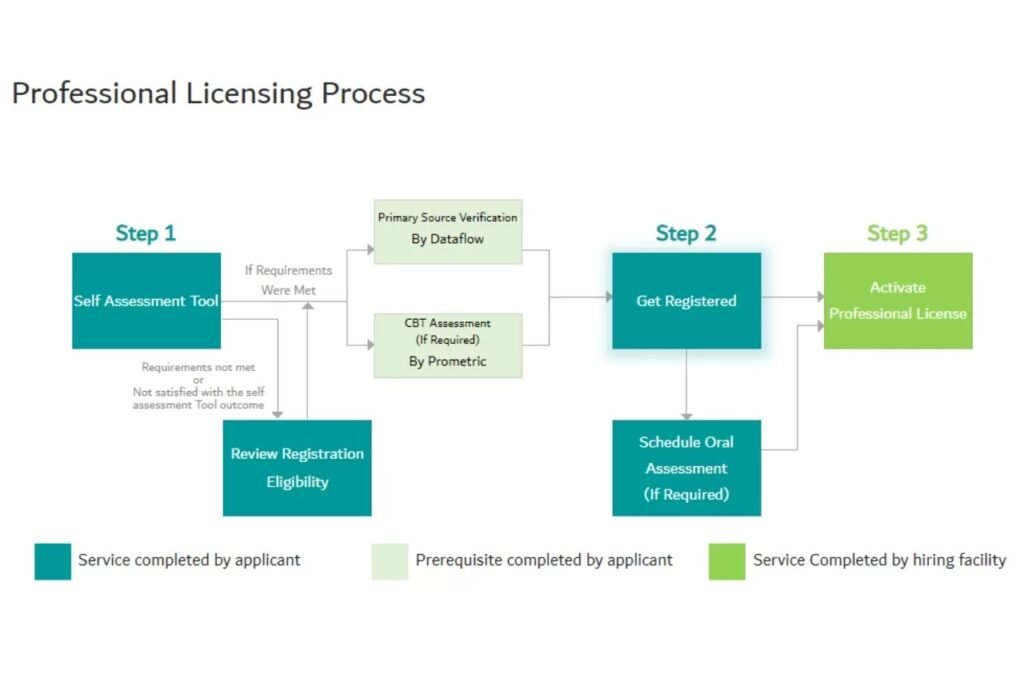
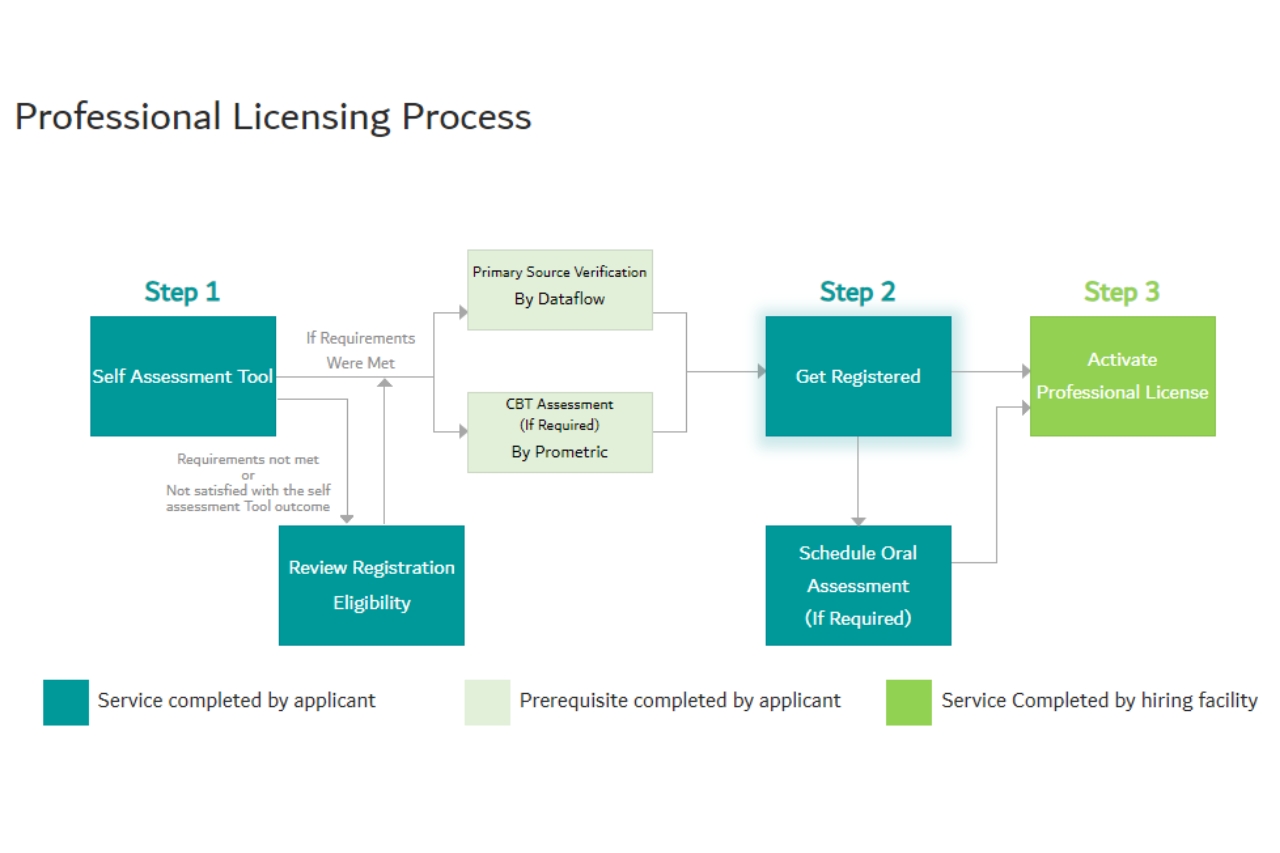
To defeat an adversary, one must understand its anatomy. The DHA exam is standardized, yet it evolves. The 2025 update brings specific constraints and focuses that distinguish it from previous iterations.
4.1 Structural Specifications
- Format: Computer-Based Testing (CBT) delivered via Prometric.
- Question Volume: 150 Multiple Choice Questions (MCQs).
- Duration: 165 Minutes (2 hours 45 minutes).
- Passing Score: 60% (Approx. 90 correct answers) for Registered Nurses. Note: Some sources cite 50% for Assistant Nurses, but RNs must aim for 60%.
- Scoring Logic: No negative marking. An unanswered question is a missed opportunity. Random guessing is statistically mandated if time runs out.
4.2 The Syllabus Deep Dive
The syllabus is not just a list of topics; it is a blueprint of the nurse’s expected competency profile in Dubai.
4.2.1 Fundamentals of Nursing (25%)
This is the cornerstone. It does not just cover “how to make a bed.” It covers International Patient Safety Goals (IPSG).
- Key Topics: Patient identification (2 identifiers), Fall risk assessment (Morse Scale), Pressure ulcer staging (Braden Scale), Vital signs interpretation, and the Nursing Process (Assessment, Diagnosis, Planning, Implementation, Evaluation).
- 2025 Focus: Increased emphasis on Infection Control (Hand hygiene moments, PPE donning/doffing sequences, isolation precautions for airborne vs. droplet diseases like TB or COVID-19).
4.2.2 Unit Management & Leadership (22%)
This section tests the nurse’s ability to operate within a legal and ethical framework.
- Key Topics: Delegation: What can an RN delegate to an LPN or a CNA? (The RN cannot delegate assessment, teaching, or evaluation).
- Ethics: Autonomy, Beneficence, Non-maleficence, Justice, Fidelity.
- Legal: Informed consent (doctor obtains, nurse witnesses), Incident reporting (internal document, not part of patient record).
4.2.3 Adult Nursing / Med-Surg (20%)
The breadth of this section is vast, but the depth is specific to common conditions.
- Key Topics: Cardiovascular (Myocardial Infarction management – MONA protocol), Respiratory (COPD oxygen limits, Asthma management), Endocrine (Diabetes: Hypoglycemia vs. Hyperglycemia management), Gastrointestinal, and Renal failure (Electrolyte imbalances).
- Pharmacology Integration: Most med-surg questions will integrate pharmacology (e.g., “Patient has heart failure; which diuretic is anticipated? Monitor for hypokalemia.”).
4.2.4 Pediatric Nursing (18%)
- Key Topics: Growth and development theories (Piaget, Erickson), Immunization schedules (WHO/DHA standards), Pediatric dosage calculations (mg/kg), Common pediatric emergencies (Asthma, Croup, Dehydration).
4.2.5 Maternal Health Nursing (15%)
- Key Topics: Prenatal care frequencies, Naegele’s Rule (EDD calculation), Stages of Labor, Postpartum hemorrhage management, Newborn care (APGAR scoring, breastfeeding).
5. Strategic Preparation: The 4-Week “Sprint” Protocol

The difference between the 60% who pass and the 40% who fail is often structure. Randomly reading textbooks is inefficient. A structured, data-driven study plan is essential to cover the 5 domains effectively.
5.1 The Philosophy of the “Sprint”
Most candidates study for 2-3 months. However, retention curves suggest that a concentrated 4-week “Sprint” (highly intense, focused study) often yields better results for standardized testing than a protracted, low-intensity period where early topics are forgotten.
5.2 Weekly Breakdown
Table 4: The 4-Week DHA Preparation Strategy
| Timeline | Focus Domain | Actionable Tasks | Target Metric |
| Week 1: Foundations | Fundamentals (25%) | – Master IPSG goals. – Memorize Lab Values (Na, K, Ca, Mg, pH, HCO3). – Practice Infection Control scenarios. | Score >70% on Fundamentals Mock |
| Week 2: Clinical Core | Med-Surg (20%) + Peds (18%) | – Focus on “The Big 3”: Heart, Lungs, Diabetes. – Memorize Pediatric Milestones. – Daily: 10 dosage calculation questions. | Score >65% on Clinical Mock |
| Week 3: The Gap Fillers | Maternity (15%) + Leadership (22%) | – Study Delegation Rules (RN vs LPN). – Review Ethics/Legal scenarios. – Labor Stages & APGAR. | Score >70% on Leadership Mock |
| Week 4: Integration | Full Simulation | – Monday/Wed/Fri: Full 150-Q Timed Mock. – Tue/Thu: Review Rationale for every wrong answer. – Practice with on-screen calculator. | Consistent >70% on Full Mocks |
5.3 Resource Arsenal: What to Read (and What to Ignore)
The market is flooded with “Recall” files and low-quality PDFs. Reliance on these is a primary cause of failure because they often contain wrong answer keys and outdated protocols.
Recommended Resources (Tier 1):
- Saunders Comprehensive Review for the NCLEX-RN: The gold standard. While the DHA is not the NCLEX, the style of question (application-based) is nearly identical. Saunders provides the best rationales.
- Lippincott Q&A Review: Excellent for harder, alternate-format questions and deep clinical reasoning.
- Prometric-Specific Banks: Reputable online question banks that mimic the exam interface (e.g., ExamEdge, Nursing Manthra – though verify currency).
The “Recall” Trap:
“Recall” questions (memorized questions shared by past test-takers on Telegram/WhatsApp) are popular but dangerous. The DHA updates its bank frequently. Relying on 2023 recalls for a 2025 exam is a strategy for failure. Use recalls only to understand the topics being asked (e.g., “They are asking a lot about Dengue fever this month”), not to memorize the specific answers.
6. Technical Mastery: Navigating the Prometric Interface

Failure is often non-cognitive; it is technological. The Prometric interface is austere and functional. Understanding its features prevents “interface paralysis” and saves valuable seconds.
6.1 Screen Geography and Navigation
The screen layout is standardized globally.
- Timer: Located at the top right. It counts down from 165 minutes.
- Question Palette: Shows which questions are answered, incomplete, or flagged.
- Navigation: Typically “Next” and “Previous.”
- Critical Note on Navigation: While the DHA exam generally allows review, some newer Prometric exams are moving to Forward-Only navigation. Candidates must check the specific tutorial at the start of their exam. If it is forward-only, the “Mark” button becomes irrelevant for later review, changing the strategy entirely. Assumption for this report: Review is permitted, but verify on exam day.
6.2 Tools of the Trade
- Strikeout: A crucial tool for elimination. Right-click an answer to visually cross it out. This reduces cognitive load by removing distractions.
- Highlight: Candidates can highlight key words in the vignette (e.g., “sudden onset,” “child,” “allergy”). This anchors attention and prevents misreading.
- On-Screen Calculator: A basic function tool. It often pops up over the text. Practice dragging it to the side. Do not rely on keyboard shortcuts; use the mouse to click the numbers to avoid entry errors.
6.3 Keyboard Shortcuts
While the mouse is primary, some shortcuts may work (depending on the centre’s specific software version, usually TCNet).
- Previous: Ctrl + < or Alt + P
- Next: Ctrl + > or Alt + N
- Mark: Alt + M
- Warning: Do not rely on these. The mouse is safer to prevent accidental submission.
7. Psychological Warfare: Managing Test Anxiety

The “40% failure” statistic is heavily influenced by anxiety. Test anxiety reduces working memory capacity, making it difficult to retrieve information that the candidate actually knows. This is the physiological barrier to passing.
7.1 The Physiology of Panic
When a candidate encounters a difficult question early in the exam, the “fight or flight” response triggers. Heart rate increases, cortisol spikes, and “brain fog” sets in. A Reddit user described this vividly: “I completely misjudged the time… ran out of time… I am devastated…” This is a classic example of cognitive tunnelling caused by stress.
7.2 Counter-Measures: Tactical Breathing
Candidates should employ specific breathing protocols used by high-performance professionals (pilots, surgeons) to reset the autonomic nervous system.
- Box Breathing: Inhale (4s), Hold (4s), Exhale (4s), Hold (4s). This balances oxygen and CO2, reducing the physical symptoms of panic.
- Implementation: Use this during the 15-minute tutorial before the exam starts to lower baseline heart rate. Use it again if you encounter a string of 3 difficult questions.
7.3 Cognitive Reframing: The “First 10” Rule
The first 10 questions often feel the hardest because the brain is not yet warmed up (“cognitive inertia”).
- Strategy: If Question 1 is obscure, guess and move on immediately. Do not let Question 1 ruin Question 50. Mark it if allowed, but do not dwell. Accept that you will get some wrong. You only need 60%, not 100%.
8. Digital Footprint: SEO, Keywords, and the Job Hunt

In the digital age, passing the exam is only half the battle. Finding the job requires digital literacy. This section addresses the “Maximum SEO” requirement of the report by analyzing how successful candidates use search engines to bridge the gap between licensure and employment.
8.1 Keyword Analysis: What Candidates Search For
Understanding the search landscape helps candidates find the right resources and helps recruiters find them.
High-Volume Long-Tail Keywords (2025):
- “DHA nursing exam syllabus 2025 pdf free download”
- “Prometric exam questions for nurses with answers”
- “DHA license for nurses without experience” (Note: High volume, but leads to disqualification info)
- “Salary of DHA nurse in Dubai 2025”
- “Saunders comprehensive review for NCLEX-RN 9th edition”
8.2 Semantic Keywords for CV Optimization
Once the license is obtained, the candidate must optimize their CV for Applicant Tracking Systems (ATS) used by Dubai hospitals.
- Keywords to include: “DHA Eligibility Letter,” “DataFlow Verified,” “JCI Accredited Experience,” “IPSG Protocols,” “BLS/ACLS Certified”.
- Strategy: Do not just list “Nurse.” List “DHA Licensed Registered Nurse specializing in Med-Surg with JCI accreditation experience.”
9. Conclusion: From Failure to Success

The 40% failure rate of the DHA Nursing Exam is not a reflection of the impossibility of the test, but rather a reflection of inadequate preparation strategies and the “culture shock” of standardized testing. It is a filter designed to ensure that only nurses who possess both clinical knowledge and the ability to apply it under pressure enter the Dubai healthcare system.
Summary of Actionable Recommendations:
- Respect the Blueprint: Acknowledge the 2025 syllabus weightings. Do not ignore Leadership (22%) or Maternity (15%). These are the “silent killers” of the exam score.
- Train for the Format: Use CBT simulations. Practice with an on-screen calculator. Master the 66-second pace.
- Deepen the Knowledge: Move from memorization (What is X?) to application (How do I treat X in an emergency?). Use Saunders and Lippincott to build clinical reasoning.
- Manage the Mechanics: Secure DataFlow verification early. Verify eligibility criteria (2 years experience). Ensure documentation is flawless to avoid Sheryan rejection.
- Control the Mind: Implement box breathing and anxiety management techniques. Treat the exam as a mental endurance sport.
The Dubai Health Authority seeks competent, safe, and critical-thinking nurses. By aligning preparation with these core values, candidates can confidently transition from the 40% who fail to the 60% who succeed, unlocking a transformative career in the Middle East and securing their financial future in one of the world’s most vibrant healthcare economies.
10. Frequently Asked Questions (FAQ)
Q1: Can I take the DHA exam without 2 years of experience?
Generally, no. For the Registered Nurse (RN) title, 2 years of post-registration clinical experience is the standard PQR requirement. Fresh graduates are typically ineligible.
Q2: How many times can I take the DHA exam?
You have a maximum of 3 attempts. If you fail the third time, you may need to acquire additional qualifications or wait a significant period before reapplying. This “3-strike” rule makes every attempt high-stakes.
Q3: Is the NCLEX accepted in Dubai?
Not directly. Passing the NCLEX does not automatically grant a DHA license, but the knowledge base required for NCLEX is the gold standard for passing the DHA. Some reciprocal agreements exist for licenses from certain Western countries (US, UK, Canada), which may exempt candidates from the exam, but this depends on the specific license tier.
Q4: What is the passing score for 2025?
For Nurses (RN), the passing score is 60% (approx. 90/150 questions). For Assistant Nurses, it may be lower (approx. 55%), but candidates should aim for >70% in practice to be safe.
Q5: If I fail DHA, can I take the MOH or DOH exam?
Yes. While the systems are linked via the Unified Healthcare Professional Qualification Requirements (PQR), failing one does not permanently ban you from the others, though you must declare your history. However, the 3-attempt limit generally applies per authority.

Leave a Reply